
Hello
guys....I am not a photography guru....in fact I have just started to
follow my dream of being a good photographer...I did not know any of the
technicalities when I started taking photos....I had to struggle a lot
to understand the basics of photography to take good photographs without
wasting much time in settings...I know many of you have great sense of
photography without knowing much about the technicalities, but if you
know the technicalities too...it will help you to take perfect shots
more easily...
I am not an expert in all technicalities...but I am trying to learn....and sharing with you all...
Lens
Lens is one of the most vital parts of a camera and the quality of the camera mainly depends on the quality of the lens. Lenses of different types and of different focal lengths serve different purposes in photography. So to be a good photographer, it is not necessary but it is good to have some knowledge about lens.A lens is actually a transparent refracting medium(usually of glass) bounded by one or two curved surfaces. The curved surface may be spherical, cylindrical or paraboloid. For photographic purposes one of the bounded surfaces of the lens must be spherical. A lens may be considered as a combination of a number of truncated prisms of different refracting angles.
Types of lens: They are mainly of two types:
1. "Positive" or "Convex" or "Converging" lens
2. "Negative" or "Concave" or "Diverging" lens
1. Convex or Positive lens: A lens whose central part is thickest and gradually thinnest towards the edge is called Positive or Convex lens. The rays of light passing through this type of lens converge to a point hence they are also called converging lens. A convex lens is able to produce a real visible image in the screen when the later is placed behind the lens.
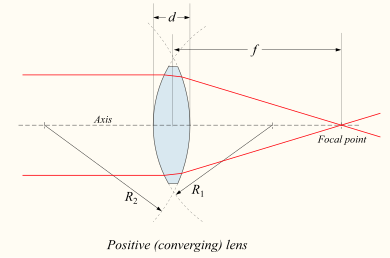 |
| Photo Courtesy: Wiki |
2. Concave or Negative lens: The lens whose central part is thinnest and gradually thicker towards the edge is called concave or negative lens. The rays of light passing through this type of lens seem to diverge from a point when the refracting rays are extended backwards. Hence it is called diverging lens. A diverging lens fails to produce any real image on screen.
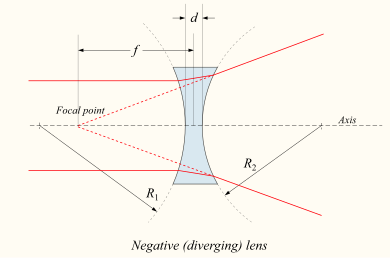 |
| Photo Courtesy: Wiki |
Positive and Negative lenses can also be divided into the following 6 lenses:
Positive Lens Negative Lens
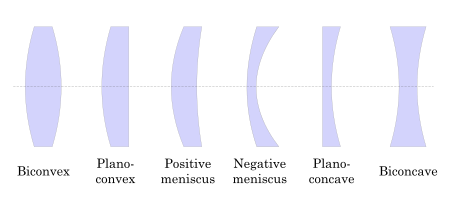 |
| Photo Courtesy: Wiki Types of Positive and Negative Lenses |
I know all these details are actually not necessary to take good photographs, but an amateur photographer like me, who doesn't have any idea of their camera, should understand a few details about it. After all, if you do not know how your weapon works, you will not be knowing how to make best use of it.
Now, there are few terms related to lens, that we will be using while explaining the other technicalities. Let us understand some of them.

In the above diagram, we have taken a spherical lens in which:
O is the optical center through which the ray of light passes undeviating.
F is the focus of the lens, a point on the principal axis through which the rays of light parallel to the principal axis passing through the lens converge to or diverge from it.
The vertical line passing through the focus is called the focal plane.
Focal length is the distance between the optical center and the focus. It is usually denoted as f.

I hope this information will help you in understanding your camera in a better way. Happy Photographing....:)
***Stay tuned for more...will update shortly...


No comments:
Post a Comment